Shop Performance Score: How the New Version Works
Official US Shop Performance Score new version: product-level scoring, BFCM protection, thresholds, benefits, and how to appeal.
The TikTok Shop Performance Score (SPS) is TikTok Shop’s 0-to-5 rating of how a US shop treats buyers. The official Introduction to Shop Performance Score New Version (US), updated 10 November 2026 and checked on 17 November 2026, is the source for every threshold, date, and formula on this page. We have not invented weights, score-tier cut-offs, or Seller Center screenshots.
This is a practical US guide, not a short news brief. It is written for sellers searching for tiktok shop performance score who need to know what changed, what is protected during BFCM, and how to read the score they already have.
What changed in the new version
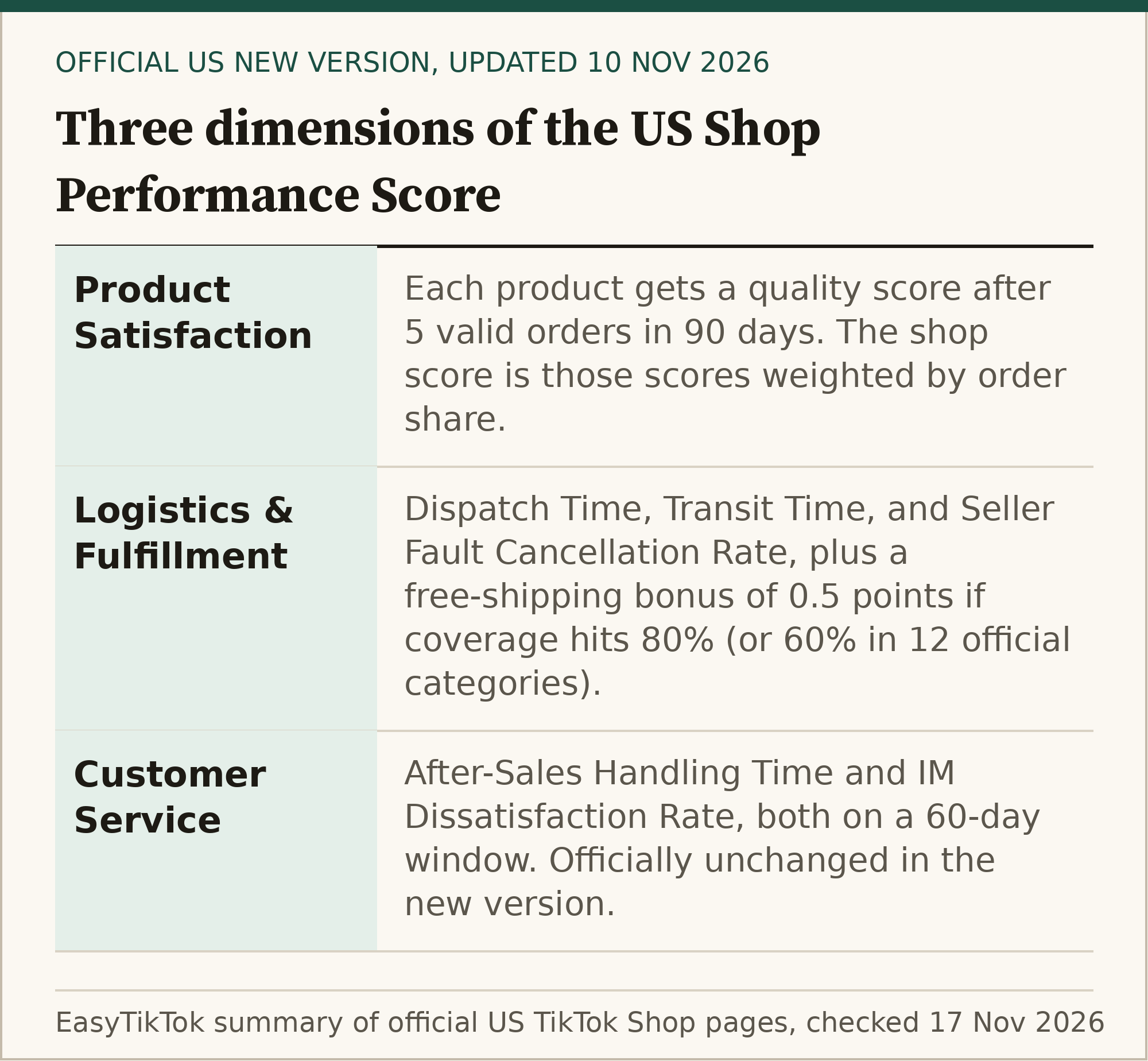
SPS still has three dimensions. The official comparison is:
| Dimension | Older focus | New version focus |
|---|---|---|
| Product Satisfaction | Shop-wide negative reviews and returns | Individual-product quality scores, then rolled up to the shop |
| Logistics & Fulfillment | Was the order on time? | Dispatch speed, transit speed, seller-fault cancellations, and a free-shipping bonus |
| Customer Service | After-sales speed and chat quality | Unchanged |
A shop score appears only when you have at least 30 completed orders in the past 90 calendar days, excluding fake orders, sample orders, and gift orders, and when at least one scoring metric has enough valid data. Official exclusions from scoring also include orders flagged for review manipulation, successfully appealed orders, negative reviews and after-sales requests caused by FBT logistics issues, and negative reviews caused by platform-subscription features.
The official total-score formula is:
SPS = Product Satisfaction × dimension weight + Logistics & Fulfillment Score × dimension weight + Customer Service Score × dimension weight
Weights are not one global table. The official page says they vary by calculation category, and that a shop is compared only with shops in the same category. That category is based on whether a category accounts for at least 60% of the shop’s order share or GMV share over the past 90 days. You can see the weights that apply to your shop in Seller Center → Account Health → Shop Performance Score.
Product Satisfaction is now scored product by product
This is the largest change. Instead of one shop-wide Negative Review Rate (NRR) and Non-Buyer Fault Return & Refund Rate (NBFR), each product gets a Product Quality Score, and the shop score is the sum of those scores weighted by each product’s share of orders.
A product needs at least 5 cumulative valid orders in the past 90 days (again excluding fake, sample, and gift orders) before it is scored. That is why some listings can show a score before the shop itself has an SPS.
Official metric windows moved from 60 days to 90 days:
- NRR: of a product’s delivered orders in the past 90 days, the share that has a 1-star or 2-star product review. A 16 October update says the system now uses the latest review status within 15 days after delivery, not the first review, and excludes negative reviews from FBT or 4PL logistics issues.
- NBFR: of a product’s delivered, non-cancelled orders in the past 90 days, the share where a seller- or logistics-partner-caused problem led the customer to request a refund or return. Only the first request counts. A 26 October update excludes platform-fault logistics issues, orders later found through arbitration not to be the seller’s fault, and after-sales requests that were cancelled after being opened.
- Positive Feedback Rate: the share of 4-star or 5-star reviews among all of that product’s reviews in the past 90 days. This is not part of the weighted score. It is a high-score gate: to finish at 4.5 or above, the product must meet the official Positive Feedback Rate standard of at least 90%. If it does not, the product score is capped at 4.4.
Product Quality Score starts as NRR score × weight + NBFR score × weight. Metric weights and the 1-to-4-point conversion bands vary by the product’s category and price band, not by the shop’s calculation category. Official examples on the page are marked as illustrations only, so we have not republished those sample percentages as if they were your category’s cut-offs. A 16 October update also says price bands use a 90-day average price, to reduce the effect of short-term price changes.
Delisted or deleted products are not removed from the lookback. Official FAQ: all products and their valid orders in the statistical period still count.
Low-order-volume protection on products
Once a product is in scoring, NRR and NBFR each get a score floor when the sample is small:
- 5 to 10 delivered orders in the denominator: default score 3.5.
- More than 10 and up to 30 orders, and no more than one problem order in the numerator: the metric is calculated normally, then floored at 3.5 if the raw score is lower.
Pre-owned is a special case
Shops whose calculation category is Pre-owned stay on the older shop-level method for Product Satisfaction. For Pre-owned products sold by shops that are not in that category, official rules updated on 16 October are: if it is one product and one order, the default score is 4.4 when NRR/NBFR is 0%, and 2.5 when it is 100%; other cases are scored normally.
Logistics & Fulfillment: faster dispatch, not just “on time”
On-Time Delivery Rate is no longer the headline logistics metric. The new scoring metrics are:
- Dispatch Time (30 days): average time from “Awaiting shipment” to “In Transit,” in hours.
- Transit Time (30 days): average time from “In Transit” to “Delivered,” in hours.
- Seller Fault Cancellation Rate (SFCR) (30 days, T-14 to T-44): share of placed orders cancelled because of a seller fault. FBT-related orders are excluded from the numerator but included in the denominator. The official page points to a separate SFCR requirements article for more detail.
- Free Shipping Coverage (7 days): a bonus, not a weighted metric. It is delivered orders with a $0 paid shipping fee, divided by all delivered orders in the last 7 days. Auction orders are excluded (16 October update).
When Free Shipping Coverage reaches the official bonus threshold, 0.5 points are added to the Logistics & Fulfillment dimension score, capped at 5. The default threshold is 80%. For 12 official lower-AOV categories, the threshold is 60%: Collectibles, Non-natural Crystal, Non-sports Trading Cards, Sports Trading Cards, Food & Beverages, Fashion Accessories, Trading Cards & Accessories, Books, Magazines & Audio, DIY, Hair Accessories, Automotive & Motorcycle, and Computers & Office Equipment.
Dispatch Time and Transit Time are not a single raw average for every fulfilment method. Official rules give FBT, Collection by TikTok, and Standard Delivery (4PL) reference standards inside the same calculation category (for example, FBT dispatch is evaluated against that category’s 5-point dispatch standard, and actual time can be replaced by the reference if it is slower). Seller Shipping (3PL) uses a standard calculation. Make-to-order and pre-order orders are excluded from Dispatch Time; back-orders use the 3.5-point dispatch standard. Less-than-truckload orders are excluded from both Dispatch Time and Transit Time. Cross-border direct-shipping orders are excluded from Transit Time. Combined or split packages are still counted by order, not by package.
Those reference hours are category-specific. The official page’s worked examples are labelled as illustrations only, so we have not copied them as if they were your cut-offs. Your numbers live on the Logistics & Fulfillment tab in Seller Center.
Shop-level protection also applies to SFCR for younger, lower-volume shops that already have an SPS: if the numerator is ≤ 3, the denominator is ≤ 30, and the shop is under 180 days old, an SFCR score below 3.5 is raised to 3.5 until the score rises on its own or those conditions no longer hold.
Customer Service is unchanged
Customer Service Score = After-Sales Handling Time score × weight + IM Dissatisfaction Rate score × weight.
- After-Sales Handling Time (AHT), 60 days: average time the seller takes to handle refund, return, cancellation, or replacement requests that the seller actually reviewed or set rules for, not requests the system approved by default. Official counting includes up to two seller stages: request approval or rejection, and later product inspection after a return arrives.
- IM Dissatisfaction Rate, 60 days: share of in-platform chat conversations with a submitted survey in which the buyer gave 1 or 2 stars. Officially, chatbot and FAQ-channel ratings are excluded.
Low-volume IM protection, for shops that already have an SPS: if the numerator is ≤ 3, the denominator is ≤ 30, and the shop is under 180 days old, the IM Dissatisfaction score has a minimum of 2. If the denominator is only 1 to 4 conversations, a 0% dissatisfaction rate scores 4.5, and 100% scores 3.
If a metric has no data, official FAQ says it shows “No data,” and its weight is reallocated to the remaining valid metrics. In the new version, Product Satisfaction has no separate metric weights for that reallocation; it is handled at the dimension level.
BFCM 2026 score protection
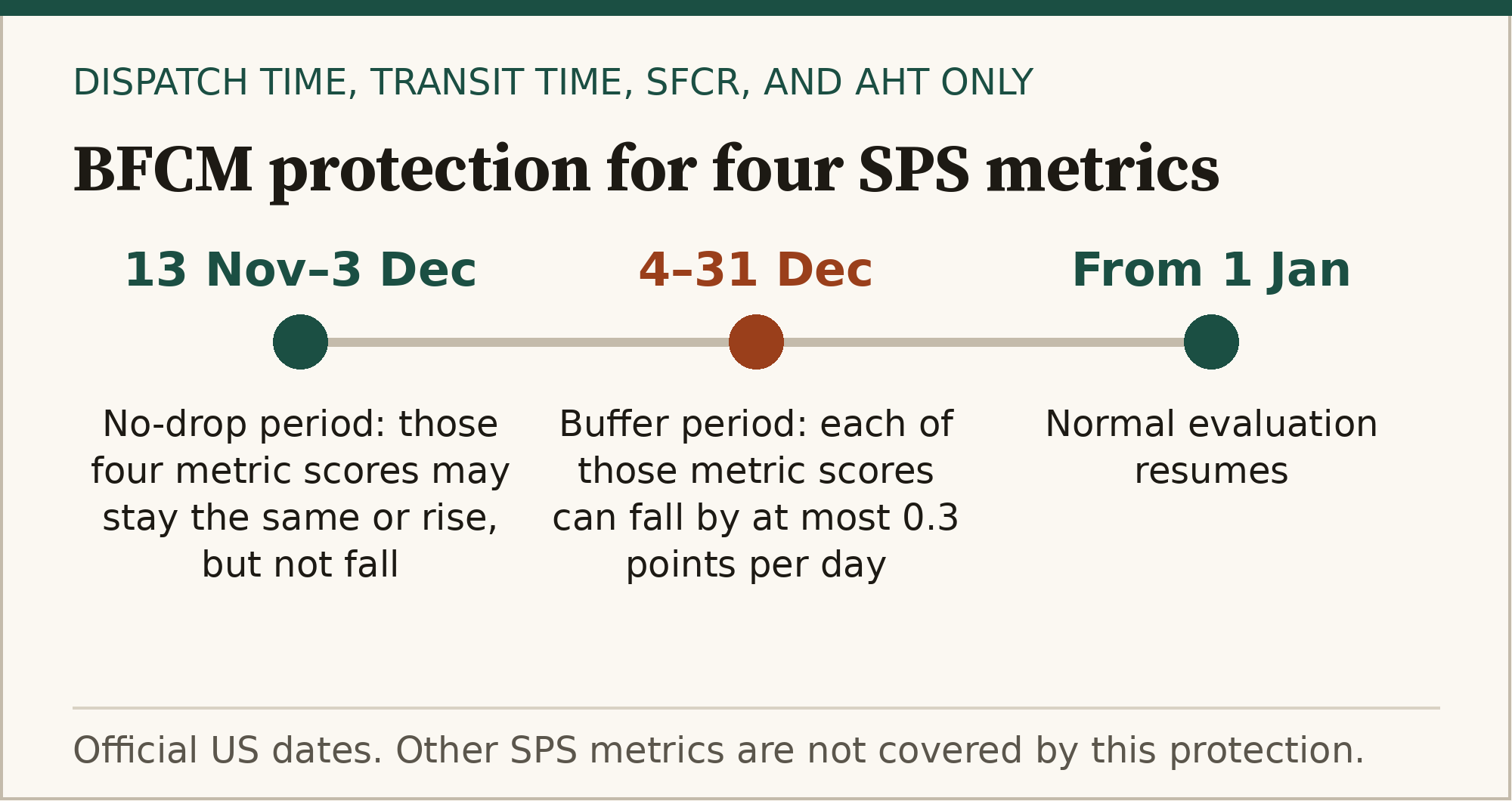
This protection is current as of 17 November 2026. To limit the effect of peak-season volume on SPS, the official US article protects four metrics: Dispatch Time, Transit Time, SFCR, and AHT.
| Stage | Official dates | Official rule |
|---|---|---|
| “No drop” period | 13 November–3 December | The four protected metric scores may stay the same or increase, but not decrease |
| Buffer period | 4–31 December | Those four metrics return toward normal scoring, but each metric score can fall by at most 0.3 points per day |
| Normal evaluation | From 1 January | Ordinary rules resume |
The official baseline is the metric scores in effect at the start of the protection period, expected on 13 November, UTC+8, subject to the actual update time, and corresponding to the 10 November score partition. If performance later improves, the effective score rises as usual. If it then worsens, the effective score stays at the higher protected level during the no-drop window.
Protection does not raise a score that was already low on 13 November. It also does not cover every SPS metric: unlisted metrics are calculated as usual. Dimension and overall scores are then calculated normally from the protected effective metric scores. If a metric temporarily has no score, the page shows no score; when a score returns, it continues from the previous effective score under the current stage’s rules.
This protection sits alongside the broader BFCM 2026 seller updates already published on this site. That news brief is not a substitute for the SPS rules above.
Benefits tied to the total score
The official article publishes these total-score benefit thresholds. Shops must also stay compliant and have no violation risk to unlock them.
| Official SPS threshold | Benefits described on the official page |
|---|---|
| 2.5 | Flash Deals (limited-time promotions) |
| 3.5 | Accelerated settlement (5 days after shipment), affiliate marketing, campaign, TikTok-funded promotions, Shop Recognition Program (brand badge eligibility), CRM access, Sales Accelerator, and graduation from probation with no limits on products or orders |
| 4.0 | Express settlement (1 day after shipment) and a Top Rated badge, with additional conditions such as shop reputation score, positive feedback rate, and sellable product count |
There is also a 3.0-point red line: if SPS falls below 3.0, official policy says affiliate and campaign benefits are revoked and related plans and products may be removed. To restore those benefits, SPS must recover to 3.5 or higher.
Treat two caveats as part of the same official page. First, it still says that during the new-version trial, New Version scores would not take effect or change current benefits, and that final New Version benefit thresholds would be confirmed at an official launch on 15 October. That date is already behind us, and the page was updated on 10 November, so we are reporting the thresholds as published rather than guessing whether your account has already switched. Check the benefits listed on your SPS overview. Second, a new “dimension traffic incentives” section says higher Product Quality Scores and higher Logistics & Fulfillment Scores may unlock greater traffic, but “the specific score requirements and incentive levels are subject to the launch.” We have not invented those levels.
How to check your score
Official paths, screenshots, and on-page figures are “for reference only; the final online UI prevails.” In that feature guide:
- On a computer, open Seller Center → Account Health → Shop Performance Score.
- The overview shows each dimension’s score and weight, and which benefits are unlocked or still locked.
- Dimension score cards show performance level and metric composition. Official advice is to start with dimensions marked as needing improvement.
- On Product Satisfaction, the product list is ordered by sales. Sort if needed, and start with high-sales products marked Poor or Needs Improvement.
We do not have an official Academy still of this screen, so we have not drawn or faked one.
How to appeal a metric
The official SPS article says you can appeal when you believe a metric was scored incorrectly, including cases caused by buyer mistakes, logistics issues, or system errors. Appealable reasons are listed by metric, among them:
- NBFR: inaccurate buyer-selected reason, perception issues, malicious return and refund, logistics issues, TikTok system issue
- NRR: malicious reviews, creator false promotion, logistics issue
- IM Dissatisfaction Rate and AHT: TikTok system issue, uncontrollable or unforeseen incident, malicious buyers
- SFCR: malicious buyers, TikTok system issue, uncontrollable or unforeseen incident
- Dispatch Time: weather or natural disasters, technical issues with Seller Center, missing scans by TikTok Shipping – Standard Delivery
- Transit Time: weather or natural disasters, technical issues with Seller Center, order IDs lost or being returned to shipper
For the click-by-click appeal method, the official page points to a separate “How to Appeal Your Shop Performance Score (SPS) Metrics” guide. We have not reproduced steps we did not fetch.
What to do this week
- Confirm whether your shop already has an SPS (30 valid orders in 90 days) and which products already have a product score (5 valid orders).
- During BFCM, do not assume every metric is frozen. Only Dispatch Time, Transit Time, SFCR, and AHT are protected, and only through 31 December 2026.
- On Product Satisfaction, work first on high-sales listings with weak NRR or NBFR, and remember the 90% positive-feedback gate if you are aiming at 4.5 or above.
- If you offer free shipping, check the official 80% or 60% coverage bonus against your last 7 days of delivered orders.
- If a specific order looks wrong, use an official appeal reason rather than waiting for the score to drift back.
FAQ
The questions below match the FAQ in the page metadata.
Sources
All pages were fetched on 17 November 2026. “Updated” dates are TikTok Shop’s own dates.
- Introduction to Shop Performance Score New Version (US) (Seller University, updated 10 November 2026). Scoring thresholds, dimension changes, BFCM protection, low-volume floors, benefits, appeals, and the Seller Center path.
- US operations context cited in our Seller Center, shipping, Fulfilled by TikTok, and return policy guides.