TikTok Shop Spain: Autónomo, Documents and Registration
How to register a TikTok Shop in Spain: official autónomo and sociedad unipersonal types, DNI, Registro Mercantil, and review times.

Spain has its own seller homepage, its own Spanish labels for business types, and a short list of IDs that is not the same as France’s. This guide is for people searching tiktok shop spain who need those Spain-specific rules in English, drawn from official pages we fetched on 17 November 2026.
It is not a find-and-replace of the France or Germany registration guides, and it does not reuse their step order as a template. The useful Spain questions are: which official label to pick if you are an autónomo, which documents actually work, and what happens after a Spain Home Shop is approved.
What the official Spain homepage actually says
The public Spain seller homepage is written in Spanish. Its FAQ, checked on 17 November 2026, is the first place to look if you are choosing a seller type or wondering whether you need a company.
Official answers, in paraphrase:
- Which seller type should I choose? The homepage lists four Spanish labels, with the definitions quoted in the next section.
- Can I sell without a registered company? Yes. If you have no business entity, select Autónomo during onboarding.
- What if I have no business address? Corporate sellers and a sociedad unipersonal should enter the address that appears on the official company register. An autónomo does not need a business address and should give a personal address.
- How do I avoid mismatches? Submit information that matches your official Spanish documents and national records exactly. Discrepancies can delay verification.
- Can one phone number or email be used for two shops? No. Each phone number and email can be used only once, globally, to register a TikTok Shop seller account. The same FAQ then notes that sellers in Germany, Belgium, Spain, France, Ireland, Italy, the Netherlands and Poland can sell in 13 European countries.
The homepage also carries marketing figures about TikTok Shop buyers. Those citations are from older US studies on the page itself, so we have not treated them as Spain performance data.
Official seller types, with the English names beside them
The English TikTok Shop EU Seller Onboarding Guide, dated 11 November 2026 and labelled “Spain local,” uses Sole Trader, Individual Seller, Privately-owned business and Publicly-listed business. Spain is in the group of countries where all four of those types are available (GbR remains Germany-only). Individual Seller is not available in Austria, Portugal, Greece, Czechia or Hungary; it is available in Spain.
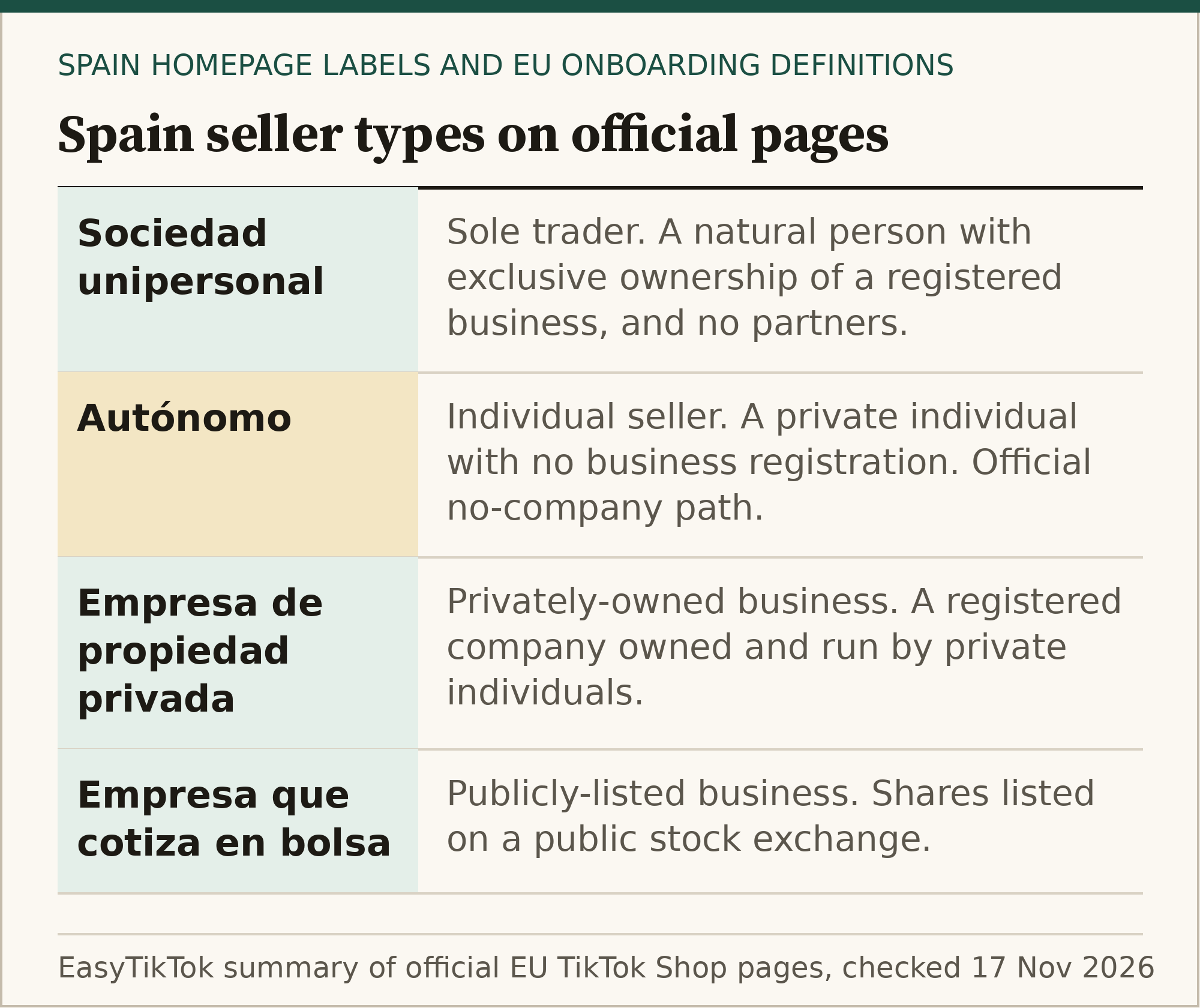
Registered companies should select Spain as the country of incorporation. Individual sellers should select Spain as the country of residence. That choice becomes your source, or Home, shop.
Documents Spain actually asks for
This is where Spain diverges clearly from France and Germany.
Identity documents
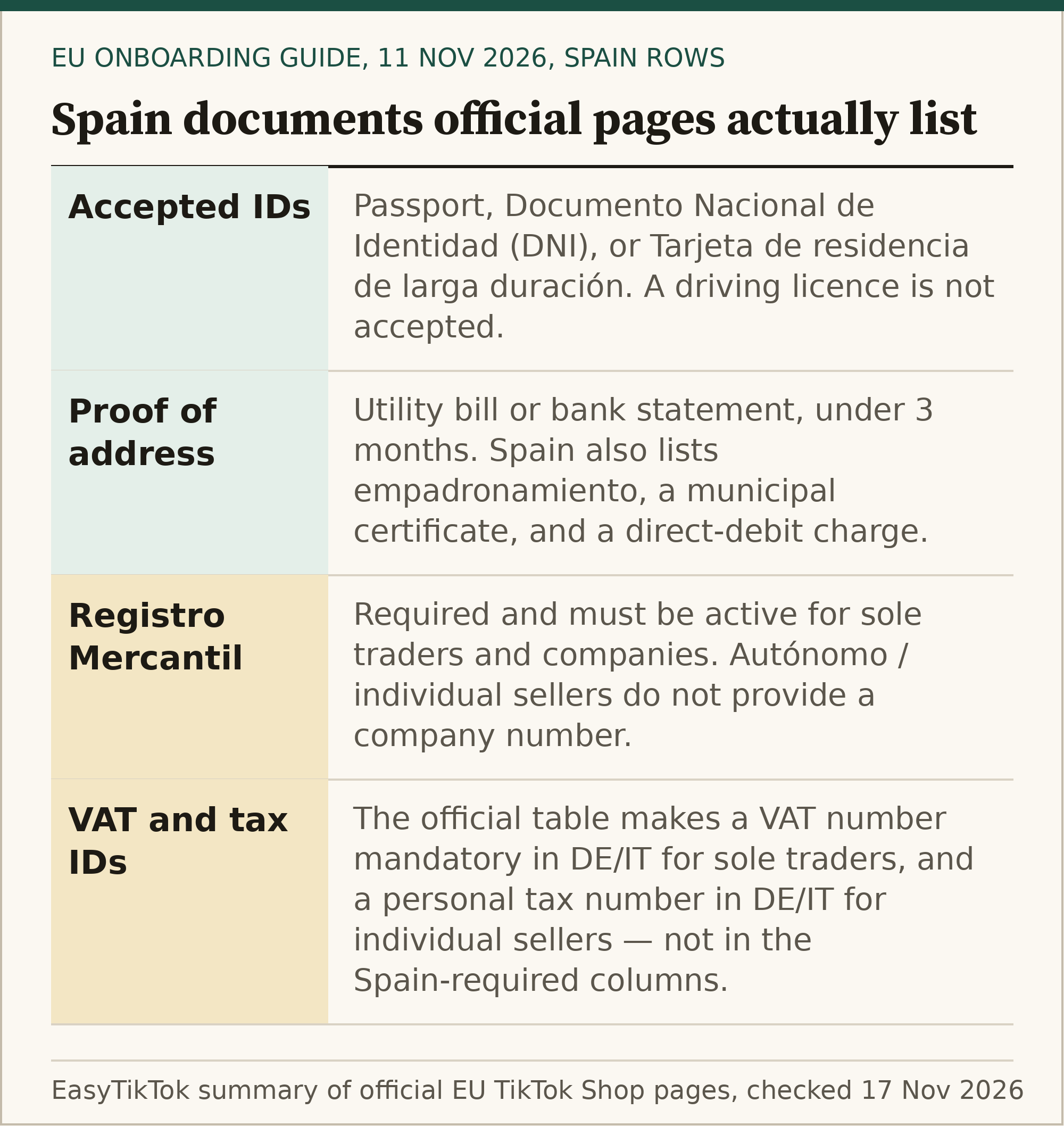
All sellers complete ID, facial and address verification. Official accepted IDs for Spain are:
A driving licence is not accepted for Spain on the official country table (the cell is marked unavailable). France, by contrast, does accept a driving licence. The document must be valid, match the registration name, and be clearly readable. Official upload guidance is to capture the front and back without crop or glare, then complete a selfie or short video for facial verification.
Proof of address
Proof of address must be less than three months old. Officially accepted in all EU countries, including Spain:
- Utility bill (water, electricity, gas, mobile or internet subscription)
- Bank statement
Officially not accepted: invoices, bank receipts, a rent bill, a home or car insurance receipt, or pension certificates.
Spain also has extra accepted documents on the official country-specific list:
- Certificado de empadronamiento individual
- Municipal Certificate
- Direct Debit Payment Charge
TikTok Shop will use this address as the default for pickup and delivery. Official text says you can change it during shop setup after the seller account is approved.
Registry, VAT and tax IDs
If you register as a sole trader (sociedad unipersonal), a privately-owned business or a publicly-listed business, the official FAQ says the company must be legally registered and active in Spain’s Registro Mercantil. Inactive, dissolved or suspended companies are not eligible. Names, registration numbers and the registered address must match the register, including spelling and abbreviations.
The official requirements summary is more specific about tax numbers than a generic “bring your NIF” checklist:
- A VAT number is required only in Germany and Italy for sole traders, and is optional except in Italy for private or public companies. Spain is not in those mandatory columns on the official table.
- A personal tax number is required only in Germany and Italy for individual sellers. Spain individual sellers (autónomo on the homepage) are not in that required column.
- Individual sellers are not asked for a company registration number.
- Every type still provides a registered business address. For an autónomo, the Spain homepage says that should be a personal address.
If a later screen in your application asks for a tax ID, enter it exactly as it appears on the official document. We are only reporting the required/optional split published in the 11 November 2026 onboarding guide, not advising on Spanish tax law.
Corporate applications also collect a representative (company director or owner, or a primary authorised user). Official rules say representatives must reside in the registered country, complete ID checks, and provide a residential address with proof. A primary authorised user must also attach a signed authorisation letter from an active company director. Some seller types may be asked for Ultimate Beneficial Owner details; official text says that step appears only when prompted.
How the application is ordered
You can register with a mobile number, email, or existing TikTok account. Each phone number or email can be used for only one seller account worldwide.
The official onboarding roadmap is not the same for every Spain seller type:
- Corporate sellers (privately-owned, publicly-listed) start with business details — company name, registration number and address — then representative selection and identity verification, then shop information, then review.
- Sole traders and individual sellers complete identity verification first, then business or tax details, then shop information, then review.
Before you submit, you add a shop name (and may upload a logo), confirm an email and phone number, and tick the required consent boxes. Official review typically takes 2–3 business days. If the application is rejected, the reason is sent to the registered email, and you resubmit from the Seller Centre homepage after correcting the documents.
After onboarding is complete, official FAQ says you may change the shop name once per month. Frequent changes are discouraged.
After approval, and Sell Across Europe
Approval is not the last step. Official FAQ says you must finish shop setup in Seller Centre before you can sell: confirm a warehouse address, complete shipping and payment setup, list at least one product, and link an official TikTok account. You do not need a TikTok account to register, but you do need one to post shoppable content or host LIVE.
Only after that Spain Home Shop is set up does Sell Across Europe (dated 13 November 2026) come into play. Officially, you can register a Home Shop in any of 13 EU markets — Germany, France, Italy, Spain, Ireland, Poland, Belgium, the Netherlands, Austria, Portugal, Hungary, Czechia and Greece — and then list and ship to the others from one Seller Centre account. Destination Shops are created automatically after Home Shop setup. Warehouse and shipping settings are copied once at the start, then later changes are managed per shop and do not stay in sync automatically. Review tax, product eligibility and rules such as EPR in each destination market.
One Spain-relevant detail from the same official guide: sellers whose Home Shop is in Germany, France, Italy, Spain or Ireland can import products from Amazon using a supported Amazon product URL. That import path is not described as available from every EU Home Shop.
All active EU shops are also subject to New Shop Probation. Official caps, across all of your EU shops combined, are 50 orders a day and 100 products at Beginner, 100 orders and 200 products at Standard, 150 orders and 1,000 products at Premium, and no such limits at Pro. Graduation in one market graduates all markets at the same time. Those are EU figures, not the US probation schedule.
When you sell, official EU commission is explained in the EU fees guide: 9% on settled orders, or 7% for eligible Electronics, inclusive of applicable taxes such as VAT, with a limited-time 4% new-seller rate if you qualify. We have not repeated that fee article here.
What to have ready
- Match the official Spain label (especially Autónomo vs sociedad unipersonal) to your documents. You cannot change the type after approval.
- Use a passport, DNI, or long-term residence card. Do not rely on a Spanish driving licence.
- If you are a sole trader or company, confirm that the business is active in the Registro Mercantil and copy names, numbers and the address exactly.
- Have a proof of address less than three months old, such as a utility bill, bank statement, or certificado de empadronamiento individual.
- After approval, finish warehouse, shipping, payout, first listing, and TikTok account linking before you sell or use Sell Across Europe.
- Price in the official 9%, 7%, or 4% rates using the EU fees guide.
FAQ
The questions below match the FAQ in the page metadata.
Sources
All pages were fetched on 17 November 2026. “Updated” or article dates are TikTok Shop’s own dates.
- TikTok Shop Spain seller homepage. Official Spanish seller-type labels, the no-registered-business Autónomo path, address guidance, and the one-phone-or-email rule.
- TikTok Shop EU Seller Onboarding Guide (Seller University, dated 11 November 2026, Spain local). Registration methods, Spain business-type availability, Registro Mercantil, Spain ID and proof-of-address rules, VAT and tax-ID columns, 2–3 business day review, and the ban on changing seller type after approval.
- Sell Across Europe: The All-in-One Guide (Seller University, dated 13 November 2026). 13 markets, automatic Destination Shops, Amazon URL import for a Spain Home Shop, and EU New Shop Probation caps.
- TikTok Shop Academy Spain. Confirms Spain Academy is active; this article relies on the pages above for verifiable rules.
- EU commission rates are cited in our EU fees guide. Country counterparts: TikTok Shop France and TikTok Shop Germany.